
Quick answer
Steel access ladders usually don’t fail HSE inspection because of one dramatic issue, they fail because of slow, hard-to-spot corrosion at specific high-stress points, weld joints, rung-to-stringer connections, and the base plate where moisture collects. A ladder can look structurally fine from a few meters away and still get flagged for exactly these reasons. This article covers what inspectors are actually looking for, and why it tends to happen faster than facilities teams expect.
The call we get most often
At EFG, a fairly common conversation starts the same way: a facilities or maintenance manager reaches out after an inspection flagged an access ladder that “looked fine” right up until someone got close enough to check it properly. It’s rarely a total structural failure. It’s almost always something specific and localized that had been quietly developing for a while.
If you manage a site with steel ladders in the UAE, this is worth understanding before your next inspection, not after.
Where corrosion actually starts, and why it’s not where you’d expect
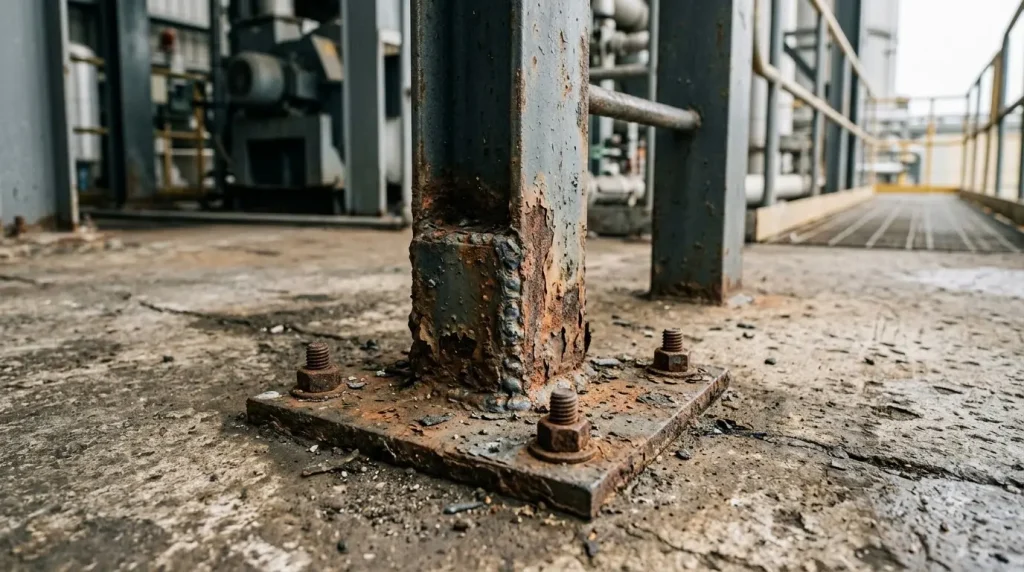
Weld joints, not flat surfaces Painted flat steel surfaces tend to hold up reasonably well, at least visibly. The weak point is almost always the weld joints, where the coating is thinnest and most likely to have been damaged during fabrication or installation. Corrosion starts under the paint at these points and can be well advanced before it becomes visible from the outside.
The rung-to-stringer connection Every mechanical fastening point on a steel ladder is a place where moisture can work its way in and sit, especially in coastal humidity or wash-down environments. This is one of the first places an experienced inspector will check closely, and one of the last places most facilities teams think to look during routine visual checks.
The base plate Wherever the ladder meets the ground or platform, water tends to collect and stay longest. Combined with reduced airflow at ground level, this is often where corrosion is most advanced, even when the rest of the ladder still looks presentable.
Why this catches facilities teams off guard
Most routine maintenance checks are visual, and a visual check from a normal viewing distance genuinely can miss early-stage corrosion at these specific points. The ladder can pass a casual look for a year or two past the point where an inspector using proper tools, a probe, close inspection of weld points, would already flag it. That gap between “looks fine” and “structurally compromised at specific points” is exactly what leads to a surprise inspection failure.
It’s also worth being honest that repainting on a schedule helps but doesn’t solve the underlying issue. A fresh coat of paint over a weld joint that already has corrosion starting underneath just hides the problem for another cycle, it doesn’t reverse it.
What this means for replacement decisions
This is the part worth thinking through before the next inspection cycle, not during it. If a steel ladder has already failed inspection once for corrosion at these points, repainting and passing it through for now is usually a short-term fix, not a resolution. The same weld joints and connection points that failed once are structurally weaker now than before, and corrosion at a compromised point typically accelerates, it doesn’t reset to zero after a repaint.
For ladders in humid, coastal, or chemical-exposure environments specifically, this is one of the more common reasons facilities teams end up specifying GRP for replacement, not because of a general preference, but because the failure mode that keeps recurring with steel simply doesn’t apply to a non-metallic structure.
Frequently Asked Questions
Why does my steel ladder look fine but keep failing inspection? Corrosion at weld joints, fastening points, and base plates often isn’t visible from a normal viewing distance, but it’s exactly what inspectors check closely. A ladder can look acceptable on casual inspection while already failing at these specific points.
Does repainting fix a ladder that’s already corroding at weld points? Repainting improves surface appearance but doesn’t reverse corrosion that’s already started under the surface at a weld joint. It’s a temporary measure, not a structural fix, particularly if the same points keep failing inspection.
How often should a steel access ladder be inspected in the UAE? This depends on the site’s environment and applicable HSE policy, but ladders in humid, coastal, or chemical-exposure areas typically need more frequent close inspection than a general visual check schedule would suggest, given how quickly localized corrosion can develop at connection points.
Is switching to GRP the only solution? Not necessarily for every site, but for ladders in environments where corrosion keeps recurring at the same points despite maintenance, replacing with a non-conductive, corrosion-resistant material like GRP addresses the underlying cause rather than repeating a maintenance cycle that isn’t holding.
Where can I get a GRP ladder built to replace a failing steel installation? EFG Composites manufactures GRP ladders at our facility in Ajman Free Zone, built to your site’s specific height, load, and safety requirements. Visit our GRP Ladder Supplier in UAE page for specifications and to request a quote.
Related reading
- GRP Ladder Supplier in UAE, full product page, specifications, and quote request
- GRP Ladder vs Steel Ladder: Which Is Better for UAE Industrial Sites?