
Quick answer
Fixed access ladders used on UAE industrial sites are commonly specified against OSHA 1910.27, the US standard covering rung spacing, pitch, side-rail clearance, and safety cage requirements for permanent ladders. It’s widely referenced across oil and gas, power, and water treatment projects in the UAE even though it’s a US regulation, because international EPC contractors and multinational operators often carry it into their own specifications. This article explains what the standard actually covers, and what to check for when a ladder is specified as compliant with it.
Why a US standard shows up in UAE tender documents
This trips people up the first time they see it. OSHA is a US federal agency, so why would a UAE facility reference it? The answer is that a large share of industrial and oil and gas projects in the UAE are run or specified by multinational EPC contractors and operators who bring their own internal safety standards with them, and OSHA 1910.27 is one of the most widely used fixed-ladder references globally, not just in the US. It’s become something close to a default technical benchmark in this sector, alongside regional and international standards like EN and BS codes.
What OSHA 1910.27 actually covers
The standard sets out specific, measurable requirements for fixed ladders, not vague guidance. The main areas it addresses:
Rung spacing and pitch Rungs on a fixed ladder must be spaced at a consistent, specified interval, and the ladder’s overall pitch (how close to vertical it is) falls within defined limits. This affects how safely and predictably a person can climb it, inconsistent rung spacing is a genuine fall hazard.
Side-rail spacing and clearance The standard specifies minimum clearance around the ladder, both the width between side rails and the clear space behind the ladder for a climber’s body and feet. This matters more than it sounds, insufficient clearance is a common reason older or improvised ladder installations fail inspection.
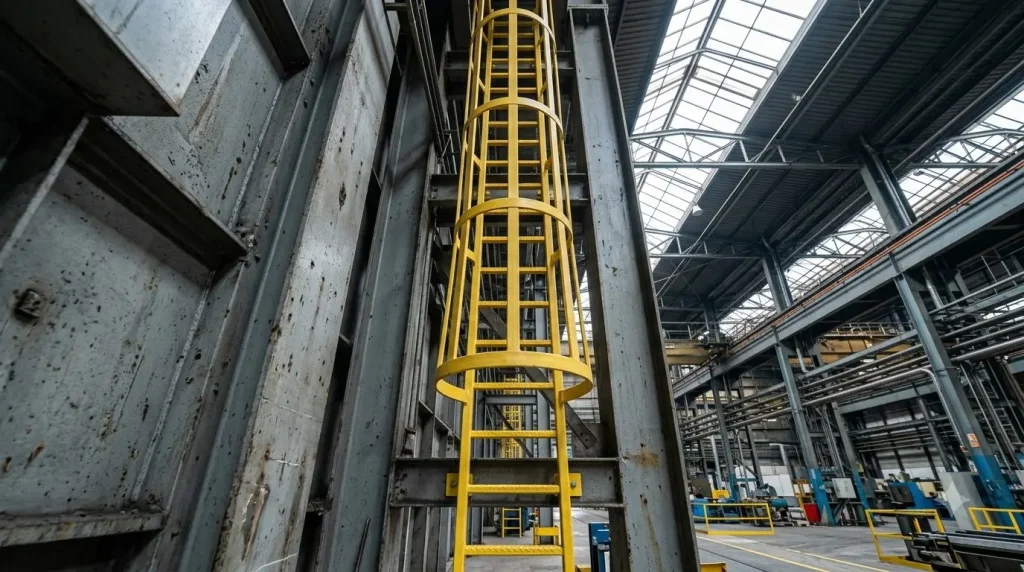
Safety cage requirements For ladders above a certain height, the standard requires a cage or well to protect against falls. This is one of the more visible compliance points, and a major reason caged GRP ladders are specified so often on taller industrial installations.
Landing platforms For very tall ladders, the standard requires intermediate landing platforms at set intervals, rather than one continuous climb, this reduces fatigue-related fall risk on long vertical access runs.
What “designed in line with” actually means
It’s worth being precise about a distinction that matters here. A ladder can be:
- Designed to align with a standard, meaning the dimensions, spacing, and configuration follow the standard’s requirements as a design input
- Tested and certified compliant, meaning an accredited third party has physically verified the finished product against the standard
These are not the same claim, and a facility manager relying on this for a compliance-sensitive installation should ask which one applies. If your project requires formal third-party certification rather than design alignment, confirm that directly with your supplier before ordering, not after installation.
What this means practically when specifying a ladder
If you’re writing or reviewing a tender spec that references OSHA 1910.27 or an equivalent standard, the practical checklist is:
- Confirm the exact rung spacing and pitch specified matches the standard’s requirements
- Confirm cage requirements based on the ladder’s total height
- Ask whether the supplier’s claim is design alignment or third-party tested certification
- Request documentation, even informal design notes, showing how the dimensions were derived
Frequently Asked Questions
Is OSHA 1910.27 legally required in the UAE? No, it’s a US regulation and not a legal requirement in the UAE. It’s used because many EPC contractors and multinational operators specify it as their internal technical standard, not because UAE law mandates it.
What’s the difference between a ladder designed to a standard and one certified to it? Design alignment means the ladder’s dimensions and configuration follow the standard’s requirements. Certification means an accredited third party has tested and formally verified compliance. Always confirm which applies before assuming a compliance claim covers what you need.
Do all GRP ladders need a safety cage? No, cage requirements are typically triggered by height thresholds defined in the applicable standard, not a blanket rule for every ladder regardless of height.
Are there other standards used alongside OSHA 1910.27 in the UAE? Yes, EN and BS standards are also referenced on many projects, particularly on European-specified installations. The applicable standard usually comes down to what the project’s EPC contractor or client specifies.
Does EFG design its GRP ladders to OSHA 1910.27? Yes, EFG designs and manufactures its GRP ladders in line with OSHA 1910.27 requirements for fixed ladders. Visit our GRP Ladder Supplier in UAE page for full specifications and to discuss your project’s exact compliance requirements.
Related reading
- GRP Ladder Supplier in UAE, full product page, specifications, and quote request
- How Much Does a GRP Ladder Cost in the UAE?