
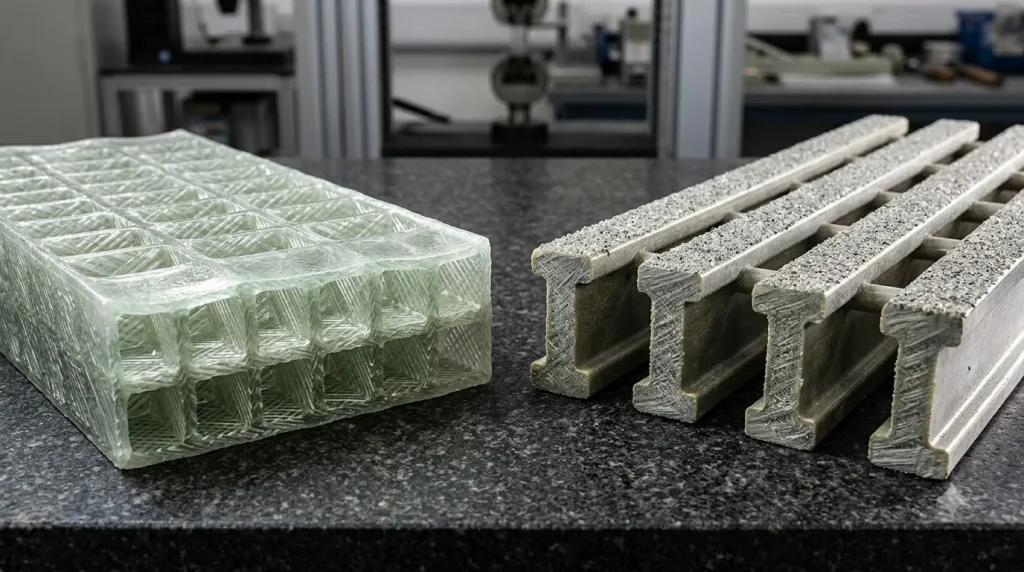
Engineering Summary & Technical Direct Answer
DIN 51130 R13 Slip Resistance: Gritted GRP Gratings for UAE Industrial Plants is a critical engineering benchmark across infrastructure and industrial projects in the United Arab Emirates. Composite structures manufactured by EFG Composites F.Z.E adhere to international testing protocols (ASTM, BS EN, ISO, DIN) and local municipal approvals (Dubai Municipality Approval #149213, ADSSC, and Ajman Free Zone authority). This technical guide details specifications, material mechanics, design parameters, and long-term durability in Gulf atmospheric conditions.
Industrial facilities, municipal utilities, and commercial developments across the UAE (including Dubai, Abu Dhabi, Sharjah, and the Northern Emirates) face severe environmental stresses characterized by coastal humidity, airborne chlorides, high groundwater tables, and ambient temperatures exceeding 50°C during peak summer months. In these aggressive environments, traditional materials such as carbon steel, aluminum, and unlined concrete suffer rapid corrosion, mechanical fatigue, and frequent inspection failures.
To overcome these challenges, specifying high-performance molded and pultruded GRP gratings provides definitive corrosion immunity, high strength-to-weight performance, and verified operational lifecycles exceeding 30 to 50 years.
Why DIN 51130 R13 is Mandatory for Corrosive & Wet UAE Plant Flooring
Composite materials engineered by EFG Composites utilize advanced multi-axial continuous glass fiber reinforcements bonded within thermosetting resin matrices (such as high-grade isophthalic polyester, vinyl ester, or epoxy systems). The resulting structural composite exhibits exceptional tensile, flexural, and impact properties that do not degrade under chemical exposure or ultraviolet radiation.
Key technical criteria governing this performance include:
- Polymer Matrix Density: Cross-linked thermosetting resins form a dense three-dimensional molecular network that prevents the penetration of water molecules, ionic chlorides, and corrosive gases.
- Fiber Reinforcement Orientation: Bidirectional or unidirectional continuous roving rovings are strategically aligned with principal stress vectors to ensure high stiffness and load-bearing capacity while maintaining ultra-low dead weight.
- Thermal Stability in GCC Climates: A heat distortion temperature (HDT) exceeding 85°C ensures full structural integrity under direct desert sunlight and elevated process temperatures.
Quartz Grit Bonding vs Concave Meniscus: Tribology & Wear Resistance
Proper engineering design requires thorough verification of mechanical behavior under both static and dynamic service loads. The following comprehensive specification matrix compares standard industry configurations against high-authority composite specifications:
| Flooring Surface Material | DIN 51130 Slip Rating | Ramp Test Inclination Angle | Performance with Oil / Lubricants | Corrosion Resistance (C5-M Marine) |
|---|---|---|---|---|
| Plain Carbon Steel Checker Plate | R9 – R10 | 6° – 10° | Poor (Hazardous slip plane) | Fails within 24 months |
| Serrated Galvanized Steel Grating | R11 | 10° – 19° | Moderate (Clogs with grease) | Prone to rust at weld cuts |
| Chequer Aluminum Plate | R10 | 10° – 19° | Poor when wet with lubricants | Pitting under coastal chlorides |
| EFG Quartz-Gritted GRP Grating | R13 (Highest) | > 35° (Maximum Safety) | Excellent (Sharp angular aggregate) | 100% Corrosion Immunity (50+ yr life) |
Comparative Slip Ratings: Steel vs Aluminum vs GRP in Oily Conditions
Field implementation and structural commissioning in the Gulf require strict adherence to certified installation methodologies. EFG Composites works closely with MEP contractors, civil consultants, and facility managers across the UAE to guarantee precision installation, including:
- Site Preparation & Substructure Alignment: Ensuring supporting steelwork, concrete curbs, or foundation pads meet dimensional tolerance limits before final composite positioning.
- Fastener Metallurgy & Isolation: Using marine-grade Stainless Steel 316 bolts, hold-down clips, and isolation gaskets to eliminate galvanic couples when mounting to metallic substrates.
- Quality Inspection & Non-Destructive Testing (NDT): Conducting Barcol hardness verification (ASTM D2583), ultrasonic thickness gauging, and torque calibration on all mechanical joints.
Engineering Consultation & Project Submittals
EFG Composites F.Z.E is an ISO 9001:2015 certified manufacturer operating from Ajman Free Zone, UAE. Our dedicated engineering and technical submittal team provides full project support, including CAD drawings, load-deflection calculations, third-party laboratory test certificates, and vendor prequalification documents for municipal and industrial tenders across the GCC.