
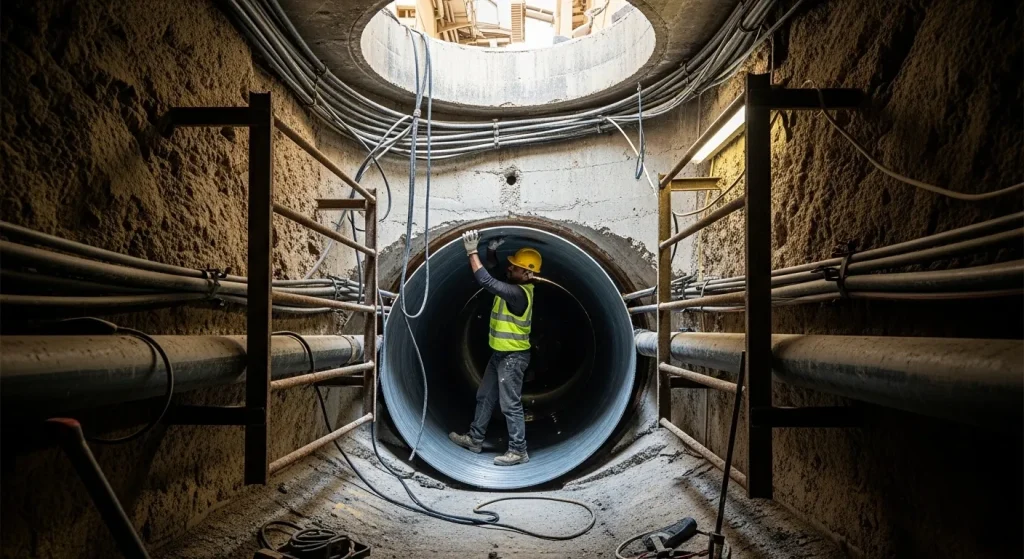
Underground infrastructure is one of the most overlooked yet critical components of urban development in the UAE. While roads, buildings, and utilities receive visible attention, systems like manholes and sewer networks operate silently beneath the surface, handling constant environmental and chemical stress.
Over time, these systems deteriorate. Corrosion, leakage, and structural damage are not rare issues. They are expected outcomes when traditional materials are exposed to harsh conditions for extended periods.
This is where GRP manhole liners and benching systems are changing the approach to infrastructure maintenance and rehabilitation in the UAE.
The Real Problem with Manhole Systems
Manholes are continuously exposed to aggressive conditions, including:
- Hydrogen sulfide (H₂S) gas buildup
- Chemical reactions within wastewater
- High moisture and humidity
- Temperature fluctuations
- Ground movement and load stress
These factors lead to gradual but serious damage.
What Happens When Manholes Deteriorate
Without proper protection or rehabilitation, manholes begin to fail in multiple ways:
- Internal corrosion weakens structural integrity
- Cracks develop, leading to leakage
- Infiltration and exfiltration issues occur
- Maintenance costs increase significantly
- Risk of collapse or system failure rises
In urban environments, these failures can disrupt entire drainage or sewer networks.
Traditional Repair Methods and Their Limitations
Historically, damaged manholes have been repaired using:
Cement-Based Coatings
- Temporary solution
- Prone to cracking and peeling
- Limited resistance to chemical attack
Full Replacement
- Expensive and time-consuming
- Requires excavation and traffic disruption
- Not always practical in urban areas
These methods often address symptoms, not the root cause.
What Are GRP Manhole Liners?
GRP (Glass Reinforced Plastic) manhole liners are engineered composite structures installed inside existing manholes to restore and protect them.
They act as a protective inner shell, isolating the original structure from harmful environmental conditions.
Why GRP Is Ideal for Manhole Rehabilitation
GRP is specifically suited for underground infrastructure due to its material properties.
1. High Chemical Resistance
GRP is resistant to:
- Hydrogen sulfide gas
- Sulfuric acid formation
- Industrial wastewater chemicals
This prevents the internal corrosion that commonly affects concrete manholes.
2. Structural Reinforcement
GRP liners do more than protect. They reinforce the existing structure by:
- Adding strength to weakened walls
- Reducing the risk of collapse
- Extending the service life of the manhole
3. Corrosion Prevention
Unlike traditional materials, GRP does not corrode.
This makes it a long-term solution rather than a temporary fix.
4. Smooth Hydraulic Flow
GRP benching systems improve internal flow by:
- Reducing turbulence
- Preventing sediment buildup
- Enhancing overall drainage efficiency
5. Watertight Sealing
GRP liners create a sealed environment that:
- Prevents leakage
- Eliminates groundwater infiltration
- Protects surrounding soil and infrastructure
Trenchless Rehabilitation: A Major Advantage
One of the biggest benefits of GRP manhole liners is that they can be installed without major excavation.
This is known as trenchless rehabilitation.
Benefits include:
- Minimal disruption to traffic and public areas
- Faster project completion
- Lower labor and restoration costs
- Safer working conditions
In dense urban areas across the UAE, this approach is essential.
Applications in UAE Infrastructure
GRP manhole liners are widely used in:
- Municipal sewer systems
- Stormwater drainage networks
- Industrial wastewater systems
- Infrastructure upgrade projects
- Smart city developments
They are especially valuable in older systems that require upgrading without full replacement.
Lifecycle Cost Advantage
Many infrastructure decisions are still made based on initial cost alone.
However, long-term performance tells a different story.
Traditional Repair Methods
- Frequent maintenance
- Short lifespan
- Recurring repair costs
GRP Lining Systems
- Minimal maintenance
- Extended service life
- Reduced long-term expenditure
Over time, GRP solutions provide significantly better value.
Addressing H₂S Corrosion: A Critical Issue
Hydrogen sulfide gas is one of the most damaging elements in sewer systems.
It reacts with moisture to form sulfuric acid, which aggressively attacks concrete surfaces.
GRP liners act as a barrier, preventing this chemical reaction from damaging the structure.
This is one of the key reasons why GRP is increasingly preferred in modern sewer rehabilitation projects.
Installation Process Overview
A typical GRP manhole rehabilitation process includes:
- Inspection and condition assessment
- Cleaning and surface preparation
- Installation of the GRP liner
- Sealing and finishing
- Integration with existing pipeline systems
The process is efficient and significantly faster than full replacement.
Choosing the Right GRP Solution Provider
The effectiveness of a GRP liner system depends heavily on design and execution.
Key factors to consider include:
- Material quality and thickness
- Engineering precision
- Installation expertise
- Experience with similar projects
- Compliance with standards
A poorly designed system can fail to deliver expected results.
Strategic Infrastructure Upgrade
For municipalities, contractors, and infrastructure developers, rehabilitation is not just about fixing damage. It is about extending the life of assets and reducing future risks.
For reliable and engineered solutions tailored to UAE conditions, working with an experienced
https://efgcomposites.ae/grp-manhole-liners-benching-manufacturer-in-the-uae/
ensures that infrastructure upgrades are both effective and long-lasting.
Manhole deterioration is not a question of if, but when. The key is choosing the right solution before failures escalate into costly problems.
GRP manhole liners offer:
- Long-term protection
- Structural reinforcement
- Chemical resistance
- Cost efficiency
In a region like the UAE, where infrastructure must withstand extreme conditions, GRP is not just an upgrade. It is a necessary evolution in how underground systems are maintained and protected.