
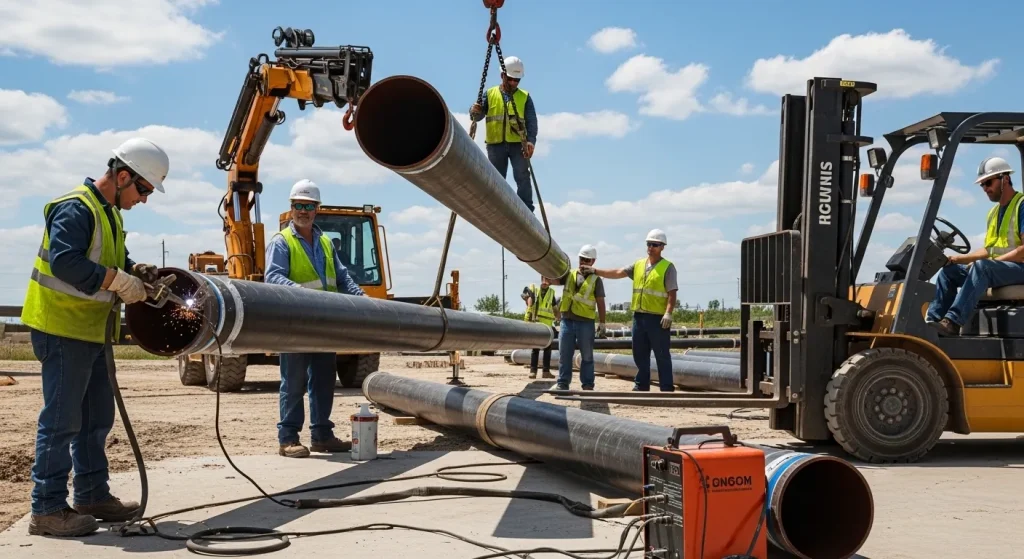
In the UAE, piping systems are not just part of infrastructure. They are long-term investments that directly impact operational efficiency, maintenance costs, and system reliability. Industries such as oil and gas, desalination, water treatment, and chemical processing depend heavily on piping performance under extreme conditions.
For decades, steel and PVC have been the default choices. However, the limitations of these materials are becoming increasingly evident in the UAE’s harsh environment. As a result, GRP (Glass Reinforced Plastic) and GRE (Glass Reinforced Epoxy) piping systems are gaining widespread adoption.
This shift is not driven by trends. It is driven by performance, lifecycle cost, and the need to reduce long-term risk.
Environmental Challenges That Affect Piping Systems in the UAE
The UAE presents a uniquely demanding environment for industrial materials. Piping systems are constantly exposed to:
- High salinity in soil and groundwater
- Extreme temperatures and thermal fluctuations
- Chemical exposure in industrial processes
- Sand and abrasive conditions
These factors accelerate wear, corrosion, and structural degradation, especially in traditional piping materials.
Limitations of Steel Pipes
Steel pipes are known for their strength and load-bearing capacity. However, in UAE conditions, their weaknesses become significant over time.
- Corrosion is unavoidable, even with protective coatings
- Cathodic protection systems increase complexity and cost
- Internal scaling reduces flow efficiency
- Maintenance and repair costs accumulate over time
In many industrial projects, the long-term cost of maintaining steel piping far exceeds its initial installation cost.
Limitations of PVC Pipes
PVC is often chosen for its affordability and ease of installation. However, it is not designed for demanding industrial applications.
- Limited resistance to high temperatures
- Lower mechanical strength compared to industrial requirements
- Degradation under prolonged UV exposure
- Unsuitable for high-pressure systems
While PVC may work for light-duty applications, it is not a reliable long-term solution for critical infrastructure.
Understanding GRP and GRE Pipes
GRP and GRE pipes are composite materials engineered to overcome the limitations of traditional piping systems.
They are manufactured using:
- Glass fiber reinforcement for structural strength
- Thermosetting resins such as polyester, vinyl ester, or epoxy
The result is a material that combines strength, durability, and resistance to environmental stress.
Key Advantages of GRP/GRE Piping Systems
1. Corrosion Resistance
GRP pipes are inherently resistant to corrosion. Unlike steel, they do not require coatings or cathodic protection.
They can handle:
- Saltwater and marine environments
- Industrial chemicals
- Moisture and humidity
This makes them particularly suitable for coastal and industrial applications in the UAE.
2. Long Service Life
GRP piping systems are designed for long-term performance. In many cases, they can operate efficiently for decades with minimal degradation.
This reduces the need for frequent replacements and major repairs.
3. Lightweight and Easy Installation
Compared to steel, GRP pipes are significantly lighter.
This results in:
- Lower transportation costs
- Faster installation
- Reduced need for heavy equipment
For large-scale projects, this can lead to substantial savings in both time and labor.
4. High Strength-to-Weight Ratio
Despite being lightweight, GRP pipes offer excellent structural strength. They can handle high pressure and demanding operational conditions without compromising performance.
5. Smooth Internal Surface
GRP pipes have a smooth internal finish, which provides:
- Better flow efficiency
- Reduced friction losses
- Minimal scaling or buildup
This improves system performance and reduces energy consumption over time.
6. Low Maintenance Requirements
Since GRP pipes do not corrode or degrade easily, maintenance requirements are significantly lower compared to steel systems.
This reduces:
- Operational downtime
- Maintenance costs
- Risk of unexpected failures
Applications of GRP/GRE Pipes in the UAE
GRP piping systems are widely used across multiple industries, including:
- Oil and gas infrastructure
- Desalination plants
- Water treatment and distribution
- Chemical processing industries
- Marine and coastal projects
Their versatility makes them suitable for both above-ground and underground installations.
Lifecycle Cost Comparison
Initial cost is often the deciding factor in material selection. However, this approach can be misleading.
Steel Systems
- Lower initial cost in some cases
- High maintenance and protection costs
- Frequent repairs and replacements
GRP Systems
- Competitive initial cost
- Minimal maintenance
- Longer service life
When evaluated over 15 to 25 years, GRP systems often prove to be more cost-effective.
Performance in Desalination and Water Infrastructure
The UAE relies heavily on desalination for water supply. These systems require materials that can handle continuous exposure to saltwater and chemicals.
GRP pipes are well suited for this environment because they:
- Resist salt-induced corrosion
- Maintain structural integrity over time
- Support efficient water flow
This makes them a preferred choice for modern water infrastructure projects.
Installation Efficiency and Project Timelines
Project timelines are critical in industrial and infrastructure developments.
GRP piping systems help reduce delays by:
- Simplifying handling and transportation
- Allowing faster jointing and installation
- Reducing dependency on complex protection systems
This leads to faster project completion and lower overall costs.
Selecting the Right GRP Pipe Manufacturer
The performance of a GRP piping system depends heavily on manufacturing quality.
Key factors to evaluate include:
- Quality of raw materials
- Engineering and design standards
- Experience in industrial applications
- Compliance with international standards
- Technical support and after-sales service
Choosing the wrong supplier can compromise the entire system.
Strategic Material Selection for Long-Term Reliability
For industrial projects where reliability, efficiency, and cost control are critical, selecting the right piping material is not optional.
It is a strategic decision.
For engineered piping solutions designed to perform under UAE conditions, working with an experienced
https://efgcomposites.ae/grp-gre-pipes-fittings-manufacturer-in-the-uae/
ensures that the system delivers long-term value.
The shift from steel and PVC to GRP and GRE piping systems is not temporary. It reflects a broader move toward materials that offer better performance, lower maintenance, and longer service life.
In the UAE, where environmental conditions are demanding and operational efficiency is essential, GRP piping systems provide a clear advantage.
For industries that cannot afford failure, investing in the right material from the beginning is the most cost-effective decision.